Average Reviews:

(More customer reviews)I have owned the Digiadapt for a few months, used with an Olympus Camedia D-535 camera and a Sunpak 383 flash unit.I have been disappointed with the Digiadapt unit and would not recommend it except for unusual cases where it might fit in.
The problem that comes up with the very nice small digital cameras is the weak flash, close to the lens, that cannot be aimed.These small digital cameras take great pictures in good lighting conditions, like outside in daytime.Indoors or at night you must use the flash.The built in flash is weak, and won't reach out much more than about 5 feet.The flash is close to the lens, giving a lot of red-eye.The flash can't be aimed to use bounce and give a more natural look.
Users of these cameras start looking for a more powerful flash that can be aimed, or at least set off a little way from the lens.They find, of course, no hot shoe for a flash, and no socket to plug a flash unit in with a cord.Why the manufacturers wouldn't at least give a flash sync socket on at least some models, I don't know.It wouldn't take up a lot of space or add weight, but anyway, unless you have a camera with a hot shoe, there is no way to hook up an accessory flash unit.
That is where a slave adapter comes in.The slave adapter "sees" (senses) the built in flash from the camera and triggers an accessory flash unit hooked up to the hot shoe of the adapter.It seems that it is a little more difficult than just this because the digital cameras commonly use one or more "pre-flashes" to gather data and adjust settings, then the real flash comes at the time of the picture.If you have a simple slave unit, it will flash with the first pre-flash, then when the right time comes a few millisecond later, at the time of the real flash, the accessory flash won't fire, and so the accessory flash doesn't help light the shot.To solve this, the digital camera slave manufacturer will program the slave unit to ignore one or more "pre-flashes" and then trigger the accessory flash on the 2nd or 3rd or 4th flash it sees, instead of the first one.
The Digiadapt is adjustable in 5 discrete modes, which adjusts how many flashes are ignored before triggering the accessory flash unit.Which mode you are in is indicated by LED lights on the back of the unit.There is no table that I have found that tells you what mode to use with what camera.You figure this out by shooting a series of trial shots and seeing what seems to work best.
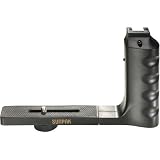
The unit is an L-shaped bracket, with a mounting screw on the horizontal arm of the L for the camera.The vertical arm of the L is a battery compartment and integral grip with a hot shoe at the top for the accessory flash, and the sensor for the flash on the top front of the unit.Holding this assembly with the camera and flash attached is really very comfortable and "natural."The grip is nice, and makes holding a relatively heavy flash head easy.The assembly looks nice.The unit takes 4 AA batteries, and just as a casual observance, it seems to use up the batteries quicker than what I expected it to.If the unit is off, there is a 5-10 second delay after it is turned on before it is ready to go.
The problem with this otherwise very nice unit is that it will not fire the accessory flash reliably, when used in this mode attached to the camera.The system depends on enough of the flash reflecting back from nearby objects in front of the camera to the sensor on the front of the digiadapt.If you are in a small room with light colored walls, enough flash bounces back to the sensor to make the slave flash pretty reliable, but not 100%.Outside of this situation, i.e. outside, in a large room, or a room with dark colored walls, the sensor doesn't get enough bounceback light from the flash to work, and just is not usable.This inability to work as it seems to have been designed for is why I could not recommend it.
I noticed that another reviewer had mentioned not having the adapter on the camera, but having the adapter and accessory flash mounted on a tripod separate from the camera.That you could make work, if you placed the Digiadapt fairly close to the camera, but off to the side enough to be not in the picture, and pointed the sensor at the camera, so it "sees" the flash from the camera.The Digiadapt doesn't have the capability of turning or tilting the hot shoe, but many flash units I think do have the capability of turning and tilting, so you could have the sensor pointed back at the camera, and the accessory flash pointed however you wanted it.But setting up the Digiadapt on a separate tripod seems to me to be something you could really do only in a studio type situation.For this type of setup, the Digiadapt could actually work pretty well, I think.
I have tried holding the camera and the Digiadapt separately, holding the Digiadapt out at arms length, with the sensor aimed back at the camera, out of the angle of the picture, and been able to get that to work fairly well, but this arrangement is too unwieldy to really use.
I haven't had the opportunity to try the Digiadapt with other camera models, or to try other slave adapaters.I hope this review may be of some use to interested readers.
Click Here to see more reviews about: Sunpak Digital Camera Flash Adapter
Product Description:
While ToCAD is a name most people won't recognize immediately the products it markets are very well known. Sunpak electronic flash units, video lights, camcorder batteries and cellular batteries, Sunpak photo and video tripods and different accessories, Zero Halliburton aluminum photo/video and computer cases, and GE/Sanyo lithium batteries. All are names photo enthusiasts and professionals respect and rely upon for high quality and great value.
 Get 56% OFF
Want to read more honest consumer review about Sunpak Digital Camera Flash Adapter now ?

0 comments:
Post a Comment